Keyword research has always been one of the most important parts of SEO—and also one of the most frustrating.
You start with a seed keyword, open a dozen tabs, dig through search volume metrics, compare keyword difficulty scores, and try to guess which keyword variations will actually rank. Then you build a list… but you’re still not fully confident it’s the right list.
Because the truth is: keyword research isn’t about collecting keywords.
It’s about identifying search opportunities, understanding search intent, and building a strategy that supports topical authority.
That’s why an ai keyword research tool is quickly becoming essential. Not because it’s trendy, but because it helps marketers and SEO teams find better keywords faster—while making smarter decisions based on SERP reality.
In this guide, we’ll break down how AI keyword research works, what to look for in the best AI keyword research tools, and how to turn keyword insights into rankings (and revenue).
Why Keyword Research Is Still the Biggest SEO Bottleneck
Even though SEO has evolved, keyword research is still where most teams lose time.
Traditional keyword research looks like this:
- pick a keyword
- check search volume
- check keyword difficulty
- export keyword ideas
- manually filter
- try to cluster keywords
- guess what to publish first
This process is slow and often misleading.
Because two keywords can have the same search volume but completely different outcomes depending on:
- SERP features (People Also Ask, featured snippets, video carousels)
- competition quality (forums vs brands vs publishers)
- intent alignment (informational vs commercial vs transactional)
- conversion potential
That’s why the best SEO teams don’t just ask:
“What keywords have volume?”
They ask:
“What keywords represent a real opportunity to rank and convert?”
And this is exactly where AI keyword research tools change the game.
What an AI Keyword Research Tool Actually Does?
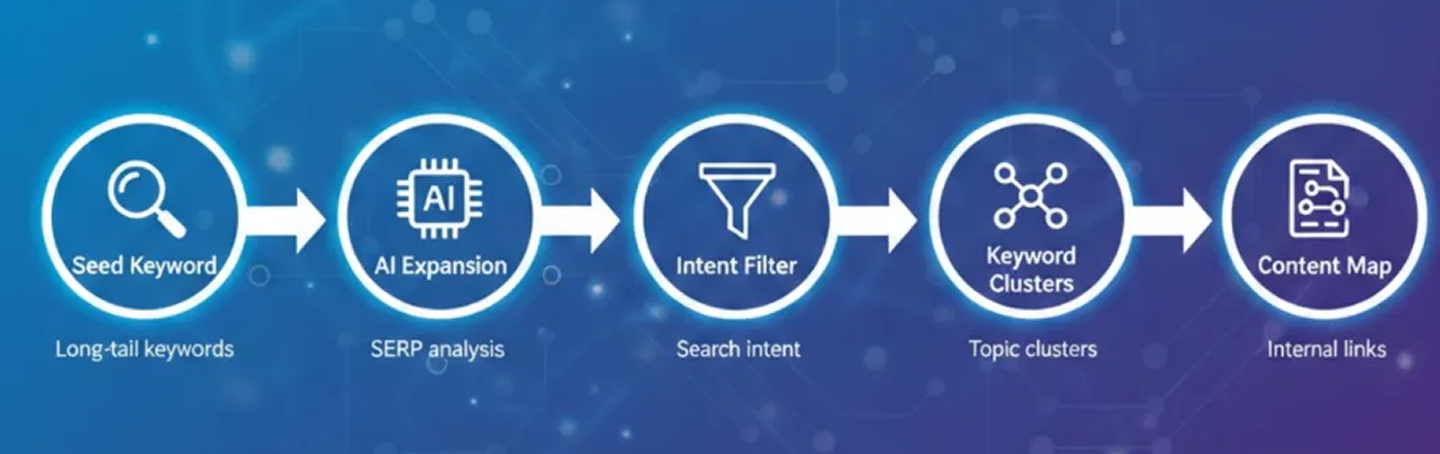
A lot of people assume AI keyword research is just keyword generation.
But the best ai powered keyword research tool goes deeper.
It uses machine learning and natural language processing (NLP) to understand relationships between search queries, entities, and intent—so you can build a smarter keyword plan.
Instead of only showing you keyword variations, it can help you:
- detect keyword intent (informational/commercial/transactional)
- run SERP analysis faster
- identify semantic keywords and entity relationships
- automatically cluster keywords into topic groups
- surface long-tail keywords that humans often miss
- map keywords to content types (pillar page vs blog vs landing page)
Tools like Ahrefs, Semrush, Moz, and Ubersuggest have made keyword discovery easier for years—but AI-focused platforms now take it further by combining SERP intelligence with automation and clustering.
That’s why newer AI-driven SEO platforms like Search Atlas, Surfer SEO, Frase, Clearscope, and MarketMuse are increasingly becoming the go-to stack for content teams that want speed and precision.
And importantly: Search Atlas’ OTTO SEO Tool belongs in this category too—because it supports keyword research workflows, keyword discovery, and keyword-driven planning, not just implementation.
So the real value isn’t “more keywords.”
It’s better decisions, faster.
Why AI Helps You Find Better Keywords Faster
1) Faster keyword discovery
AI compresses hours of research into minutes.
You can start with one seed keyword like “ai keyword research tool” and instantly generate:
- related keywords
- question keywords
- comparison terms
- modifiers (best, free, for ecommerce, for agencies)
- long-tail keywords with conversion intent
This means you can build a full keyword universe quickly—without drowning in spreadsheets.
2) Better intent targeting
Search intent is everything.
A keyword might look promising, but if the SERP is filled with:
- product pages
- category pages
- tool pages
…and you publish a blog post, you’re fighting uphill.
AI makes it easier to classify intent and align content type with what Google is rewarding.
3) Smarter keyword clustering
Keyword clustering is one of the biggest SEO advantages today.
Instead of creating random pages targeting random keywords, AI helps you group terms into topic clusters, so you can build:
- a pillar page
- supporting articles
- internal linking structure
- content map that grows authority
This is how you win semantic search.
4) Easier prioritization
Most teams waste months on keywords that aren’t worth it.
AI helps you prioritize based on:
- ranking potential
- SERP competition
- intent strength
- keyword opportunity
- business relevance
It’s not just about “low KD.” It’s about high ROI.
What to Look For in the Best AI Tools for SEO Keyword Research
If you’re evaluating AI tools for SEO keyword research, look for features that go beyond surface metrics.
Here are the big ones:
SERP analysis + SERP features
Your tool should analyze what’s ranking and why.
Including:
- content format trends
- People Also Ask questions
- featured snippet patterns
- competitor page structure
Keyword clustering and topic modeling
You want automated grouping that supports topical authority.
Keyword gap analysis
A strong tool should show competitor keywords you’re missing—this is often the fastest way to steal market share.
Semantic and entity support
The best tools help you cover the entities Google expects around a topic (instead of writing thin content).
A Fast Workflow: How to Use an AI Keyword Research Tool
Here’s a workflow you can run in under an hour:
Step 1: Define the goal
Are you trying to drive:
- traffic?
- leads?
- demo requests?
- ecommerce sales?
This affects which keywords matter.
Step 2: Enter seed keyword
Example:
- ai keyword research tool
Step 3: Expand keyword ideas
Generate:
- keyword variations
- long-tail keywords
- questions
- comparisons
Step 4: Filter by intent
Sort keywords into:
- informational (top funnel)
- commercial (mid funnel)
- transactional (bottom funnel)
Step 5: Cluster keywords
Group into topic clusters.
Example cluster:
- ai keyword research tool
- ai powered keyword research tool
- ai tools for seo keyword research
- keyword clustering ai
- semantic keyword research
Step 6: Build content map + internal linking plan
Decide:
- pillar page topic
- supporting posts
- internal link anchors
This is where you stop being “a content publisher” and become a strategy-driven SEO brand.
OTTO SEO Tool as a Keyword Research Tool (Not Just Execution)
Here’s what matters:
Most businesses don’t need “more keywords.”
They need a keyword strategy they can actually execute.
That’s why OTTO is positioned differently than many standalone keyword tools.
OTTO SEO Tool functions as an AI keyword research tool because it supports the full research-to-execution workflow:
- keyword discovery and keyword variations
- intent-focused keyword targeting
- keyword clustering into topic groups
- keyword-to-page mapping (so keywords don’t just sit in a spreadsheet)
- internal linking guidance aligned with clusters
- implementation support so keyword research turns into rankings
So yes—OTTO isn’t just part of SEO execution. It’s part of the keyword research system itself.
And if you want that done for you end-to-end, that’s exactly what SEO OTTO Implementer Services is built for.
A Smarter Tool Stack for AI Keyword Research
If you’re using search atlas ai seo software, you already have access to AI-driven keyword workflows that support:
- SERP analysis
- keyword clustering
- competitor insights
- semantic keyword discovery
The smartest SEO teams combine AI keyword research with a repeatable execution engine—so keyword insights turn into published content, optimized pages, and consistent ranking gains.
Final Thoughts: AI Keyword Research = Faster Decisions + Better Results
SEO isn’t about writing more content.
It’s about building authority in the right topics and targeting keywords with real opportunity.
An ai keyword research tool helps you do that faster by improving:
- keyword discovery
- intent matching
- topic clustering
- prioritization
And when you pair that with strong implementation, keyword research stops being a slow guessing game—and becomes a scalable growth system.
FAQ
What is an AI keyword research tool?
An AI keyword research tool uses machine learning and NLP to generate keyword ideas, analyze search intent, and group keywords into clusters so you can build content faster and rank more efficiently.
How does AI keyword research work?
AI keyword research works by analyzing search queries, SERP patterns, and semantic relationships to recommend keywords, identify intent, and prioritize opportunities based on ranking potential.
Is AI keyword research better than traditional keyword research?
Yes, AI keyword research is often better because it’s faster, finds more relevant long-tail keywords, improves intent matching, and automatically builds topic clusters instead of isolated keyword lists.
What are the benefits of using AI tools for SEO keyword research?
The biggest benefits include faster keyword discovery, smarter keyword clustering, better intent targeting, improved prioritization, and easier competitor keyword gap analysis.
Can AI find low-competition keywords?
Yes. AI can uncover low-competition keywords by identifying long-tail variations, niche modifiers, and overlooked intent-based queries that competitors aren’t targeting yet.