Most SEO content doesn’t fail because of bad writing.
It fails because the writer never had a clear brief.
No direction. No intent clarity. No idea what the page is supposed to rank for or why it exists in the first place. The result is predictable: decent words, weak rankings, and content that doesn’t move the needle.
A strong seo content brief fixes that.
It aligns SEO strategy, search intent, structure, and execution before a single word is written. And when done right, it becomes the difference between content that ranks accidentally and content that ranks consistently.
This post breaks down a practical SEO content brief checklist—what to include every time, why it matters, and how to create briefs that actually lead to results.
What Is an SEO Content Brief?
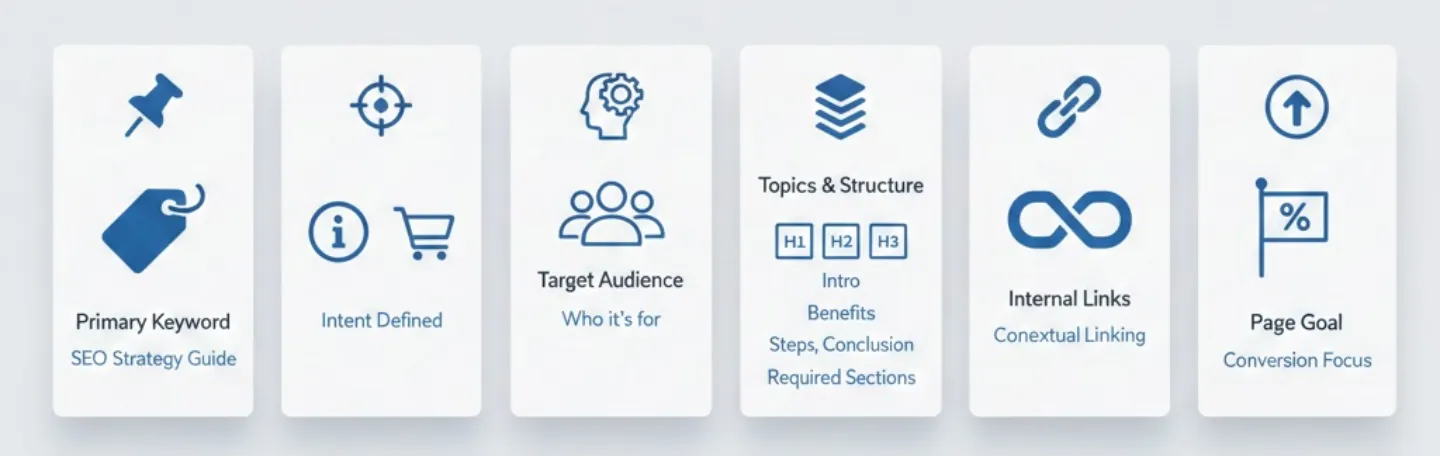
An SEO content brief is a strategic document that tells a writer exactly how a piece of content should be created to rank in search.
It defines:
- the target keyword
- search intent
- topic scope
- structure
- supporting keywords and entities
- internal links
- expectations for depth and quality
In short, it answers one question upfront:
What does Google need this page to be?
Without that clarity, content is just guesswork.
Why SEO Content Briefs Matter More Than Ever
Search has changed.
Between AI-powered results, entity-driven ranking systems, and features like AI Overviews, Google is far less forgiving of unfocused content. Pages that rank now tend to be:
- tightly aligned with intent
- clearly structured
- semantically complete
- easy for algorithms to understand
That doesn’t happen by accident. It happens because the brief forced clarity early.
If you care about visibility in modern search—including things like how to seo for google ai overview—your briefs must guide writers to produce structured, answer-first content, not fluffy blog posts.
SEO Content Brief Checklist: What to Include Every Time
This is the core of the post. If any of these elements are missing, your brief is incomplete.
1. Primary Keyword (Focus Keyword)
Every brief starts with one clear focus keyword.
Example:
- seo content brief
This keyword defines:
- the page’s main topic
- how the page should be positioned
- what it should primarily rank for
Avoid giving writers 3–5 “primary” keywords. That leads to diluted content. One page, one core keyword.
2. Search Intent (Non-Negotiable)
This is where most briefs fail.
You must specify why someone is searching the keyword.
Common intent types:
- informational (learn something)
- commercial (compare options)
- transactional (take action)
- navigational (find a brand or tool)
For example, the intent behind seo content brief is informational + practical. The reader wants a checklist or framework they can use.
If the intent isn’t stated clearly, writers will guess—and they’ll usually guess wrong.
3. Target Audience
Good SEO content speaks to a specific reader.
Your brief should answer:
- Who is this for?
- What do they already know?
- What problem are they trying to solve?
Example:
- SEO managers
- content strategists
- agency teams
- in-house marketers
This affects tone, depth, and examples.
4. Page Goal (Ranking Is Not Enough)
Ranking is not the only goal.
Define what success looks like:
- email signups
- demo requests
- internal link support
- topical authority building
When writers know the page’s purpose, content becomes more intentional.
5. Secondary Keywords & Variations
This is where LSIs come in—used naturally, not stuffed.
For this topic, examples include:
- how to create seo content brief
- seo content briefs
- how to create a standard seo content brief
These help:
- expand topical coverage
- reinforce relevance
- improve semantic understanding
List them as supporting, not equal priorities.
6. Required Topics & Subtopics
This is one of the most important sections.
Your brief should outline:
- required sections
- questions that must be answered
- subtopics that must be covered
For example:
- definition of an SEO content brief
- why briefs matter
- step-by-step checklist
- common mistakes
- tools or workflows
This prevents thin content and ensures completeness.
7. Recommended Structure (Headings)
Don’t just say “write a blog post.”
Provide a suggested structure:
- H1 topic
- core H2 sections
- logical progression
This helps writers:
- stay focused
- maintain clarity
- match how Google parses content
It also makes editing faster and more consistent across your site.
8. Internal Linking Instructions
Internal links are strategy, not decoration.
Your brief should specify:
- which internal pages to link to
- preferred anchor text
- contextual placement
For example, when discussing modern SEO requirements, linking naturally to what is search atlas ai seo software helps reinforce topical relevance and site structure.
Writers shouldn’t guess internal links. Tell them exactly what to include.
9. External References
If authoritative sources are expected:
- list them
- define expectations (cite data, examples, studies)
This improves trust and content quality.
10. Formatting & Style Guidelines
Clarity beats creativity in SEO.
Define:
- paragraph length
- use of bullet points
- tone (educational, authoritative, practical)
- avoidance of fluff
This keeps content readable for humans and algorithms.
How to Create a Standard SEO Content Brief (Simple Workflow)
If you’re wondering how to create a standard seo content brief, here’s a repeatable process.
Step 1: Analyze the SERP
Look at:
- top-ranking pages
- content formats
- common subtopics
- gaps you can fill
Step 2: Define Intent + Opportunity
Decide:
- what the reader wants
- how your page can do it better or clearer
Step 3: Build the Brief Before Writing
Outline everything:
- keywords
- structure
- links
- expectations
Only then should writing begin.
This one change alone improves content performance dramatically.
Common SEO Content Brief Mistakes to Avoid
Even teams that use briefs often get this wrong.
Mistake #1: Keyword Lists With No Context
Keywords without intent are useless.
Mistake #2: Vague Instructions
“Write a detailed blog” isn’t a brief.
Mistake #3: No Internal Linking Plan
This weakens topical authority and site structure.
Mistake #4: Treating Briefs as Optional
Your best content should always start with a brief.
Tools That Make SEO Content Briefs Easier
You don’t need dozens of tools—but the right ones help.
Platforms that support SERP analysis, keyword clustering, and entity coverage simplify brief creation. If you’re evaluating what is search atlas aseo software, it’s designed to support modern SEO workflows by helping teams understand intent, structure content, and plan topics efficiently.
The goal isn’t more data—it’s clearer direction.
From Brief to Execution: Where Most Teams Struggle
Here’s the hard truth:
Great briefs don’t guarantee rankings.
Execution does.
Many teams:
- create strong briefs
- publish content
- but fail to implement on-page SEO properly
- neglect internal linking
- don’t maintain consistency
That gap between planning and execution is where SEO momentum dies.
This is exactly what SEO OTTO Implementer Services is built to solve—taking well-defined SEO content briefs and turning them into properly implemented, optimized pages that actually perform.
Final Thoughts: A Checklist That Saves Time and Rankings
A solid seo content brief is not busywork.
It:
- aligns strategy and execution
- saves editing time
- improves consistency
- increases ranking probability
- supports AI-driven search visibility
If you want content that performs reliably, stop starting with writing.
Start with the brief.