AI didn’t break SEO.
It exposed who never understood it in the first place.
If you’ve been publishing content long enough, you’ve heard every version of the same question: Is AI content bad for SEO? Is AI-generated content good for SEO? Will Google penalize my site if I use AI?
Here’s the truth: AI content for SEO already dominates search results.
The sites winning in 2026 aren’t avoiding AI—they’re using it better than everyone else.
This guide breaks down exactly how AI content works in modern SEO, what Google actually evaluates, where most teams go wrong, and how to build AI-assisted content that ranks, scales, and stays safe long-term.
No myths. No recycled talking points. Just what works.
What AI Content for SEO Really Means in 2026
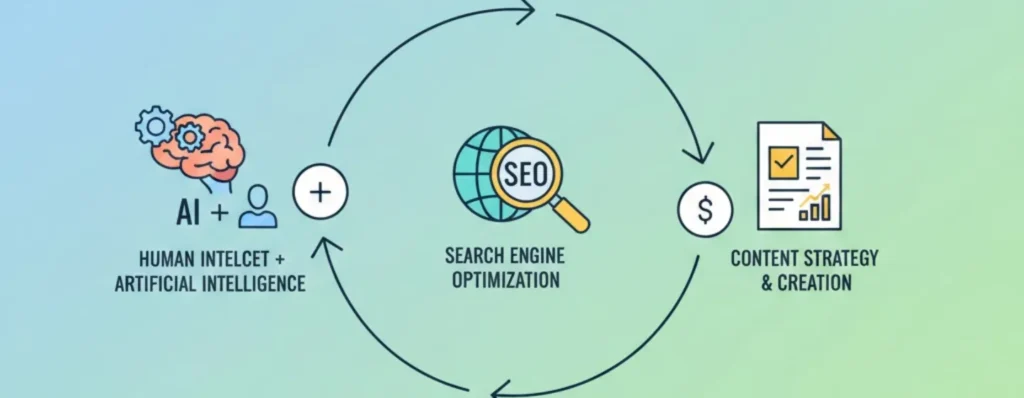
AI content for SEO does not mean dumping prompts into a model and publishing whatever comes out.
In 2026, AI content means:
- Using AI to accelerate research and drafting
- Structuring content around real search intent
- Covering topics with depth instead of surface-level summaries
- Updating and optimizing content continuously
Search engines don’t care how content is written. They care whether the content:
- Satisfies the query
- Adds value beyond what already exists
- Demonstrates relevance and credibility
AI is simply a tool. Like any tool, it’s dangerous in the wrong hands and powerful in the right ones.
Is AI Generated Content Good for SEO?
Yes—when used correctly.
Google has said this repeatedly in different ways over the years: they evaluate content based on quality, usefulness, and intent alignment—not authorship.
If AI-generated content:
- Answers the user’s question clearly
- Covers the topic thoroughly
- Is accurate and up to date
- Adds something meaningful
…it can rank just as well as human-written content.
In fact, many top-ranking pages already rely on AI for:
- Initial drafts
- Content expansion
- Topic clustering
- Refreshing outdated posts
The problem isn’t AI.
The problem is publishing unchecked, unedited, strategy-free AI output.
Is AI Content Bad for SEO? Only When It’s Used Wrong
AI content becomes bad for SEO when teams treat it like a content vending machine.
Here’s what gets sites into trouble:
1. Thin, Rewritten Content
AI summaries of other ranking pages don’t add value. Search engines detect this easily now.
2. Keyword Stuffing
Over-optimizing with exact-match keywords signals manipulation, not relevance.
3. No Editorial Judgment
AI doesn’t know what’s accurate, risky, or misleading unless you tell it.
4. No Site-Wide Strategy
Even strong pages fail if the rest of the site lacks structure, internal linking, or topical authority.
If you publish AI content without a system, the results are predictable: low engagement, no rankings, or slow decay.
How Search Engines Evaluate AI Content in 2026
Search engines have matured. Ranking today is less about isolated pages and more about context, consistency, and usefulness.
Here’s what actually matters.
Search Intent Accuracy
Does the content match why the user searched?
A page can be well written and still fail if it answers the wrong version of the question.
Topical Coverage
Single articles don’t dominate competitive queries anymore. Search engines favor:
- Content clusters
- Supporting articles
- Clear internal linking
Information Gain
What does this page add that others don’t?
This could be:
- A clearer explanation
- A better framework
- Practical steps
- Real examples
Site-Level Quality Signals
Strong content performs better on strong sites. Weak architecture drags everything down.
This is why optimization systems—like SEO OTTO Implementer services—are becoming essential. They help ensure technical SEO, internal linking, and on-page consistency keep up with content production.
The Right Way to Use AI Content for SEO
Winning with AI content isn’t about prompts. It’s about process.
Step 1: Start With a Real SEO Content Brief
Every successful AI-assisted article starts with a strong seo content brief.
A proper brief defines:
- Primary keyword and intent
- Secondary and supporting questions
- Required subtopics
- Target word count
- Internal and external link opportunities
AI should execute the plan—not create it.
Step 2: Use AI for Speed, Not Strategy
AI excels at:
- Expanding outlines
- Drafting explanations
- Generating variations
- Summarizing research
Humans should still control:
- Positioning
- Claims
- Examples
- Final editorial decisions
This balance is what separates ranking AI content from disposable content.
Step 3: Optimize at Scale, Automatically
Manual SEO doesn’t scale in 2026.
As sites grow, optimization needs to be:
- Continuous
- Automated
- Site-wide
This is where tools and services like SEO OTTO Implementer services matter. They handle internal linking, technical fixes, schema, and updates—so AI-generated content stays competitive without constant rewrites.
AI Content and EEAT: What Actually Matters Now

EEAT hasn’t disappeared. It’s just misunderstood.
Experience, expertise, authority, and trust are reinforced through:
- Clear explanations
- Demonstrated understanding
- Accurate information
- Logical structure
You don’t need to “sound human.”
You need to sound competent.
AI content supports EEAT when it’s:
- Edited with intent
- Grounded in real knowledge
- Updated regularly
Blindly publishing AI output does the opposite.
Common Myths About AI Content for SEO
“Google penalizes AI content”
False. Google penalizes low-quality content—regardless of who or what wrote it.
“AI content can’t rank for competitive keywords”
Also false. Many competitive SERPs already include AI-assisted pages.
“You have to hide AI usage”
No. Transparency doesn’t hurt rankings. Poor content does.
“Human-only content is safer”
Only if it’s actually better. Plenty of human-written content fails for the same reasons AI content does.
How to Build an AI Content Strategy That Scales
Here’s a practical framework.
1. Build Topic Clusters
Don’t publish isolated posts. Build:
- A main pillar page
- Supporting subtopics
- Clear internal links
2. Refresh Content Regularly
AI makes updates easier. Use it to:
- Expand thin sections
- Update statistics
- Improve clarity
3. Track Performance at the Page Level
Watch:
- Engagement
- Ranking movement
- Click-through rate
Improve what works. Prune what doesn’t.
4. Automate Where Possible
Scaling content without automation leads to decay. Systems matter more than volume now.
Where Most AI SEO Strategies Fail
They focus on output, not outcomes.
Publishing more content doesn’t help if:
- Intent is wrong
- Internal linking is weak
- Pages overlap or cannibalize
- Updates never happen
AI accelerates both good and bad strategies. That’s why structure matters first.
What This Really Means for SEO in 2026
AI content for SEO isn’t optional anymore.
The question isn’t whether to use AI—it’s whether you’re using it:
- Strategically
- Responsibly
- At scale
The winners will:
- Combine AI efficiency with human judgment
- Build systems, not shortcuts
- Treat content like a long-term asset
If you’re still debating whether AI content is “safe,” others are already using it to outrank you.