AI didn’t ruin content marketing. It just made lazy strategies obvious.
For years, brands got away with publishing decent blog posts, sprinkling in keywords, and waiting for traffic. That approach doesn’t work anymore. Search has evolved. Google’s AI Overviews are summarizing answers before users even click. AI-generated content is flooding the internet. And ranking now depends on depth, clarity, and structure—not just volume.
If you want to compete today, you need a real AI content strategy. Not a “let’s use ChatGPT to write blogs” plan. A system. Something intentional. Something scalable.
Let’s break this down in a practical way.
What an AI Content Strategy Actually Means
First, let’s clear something up.
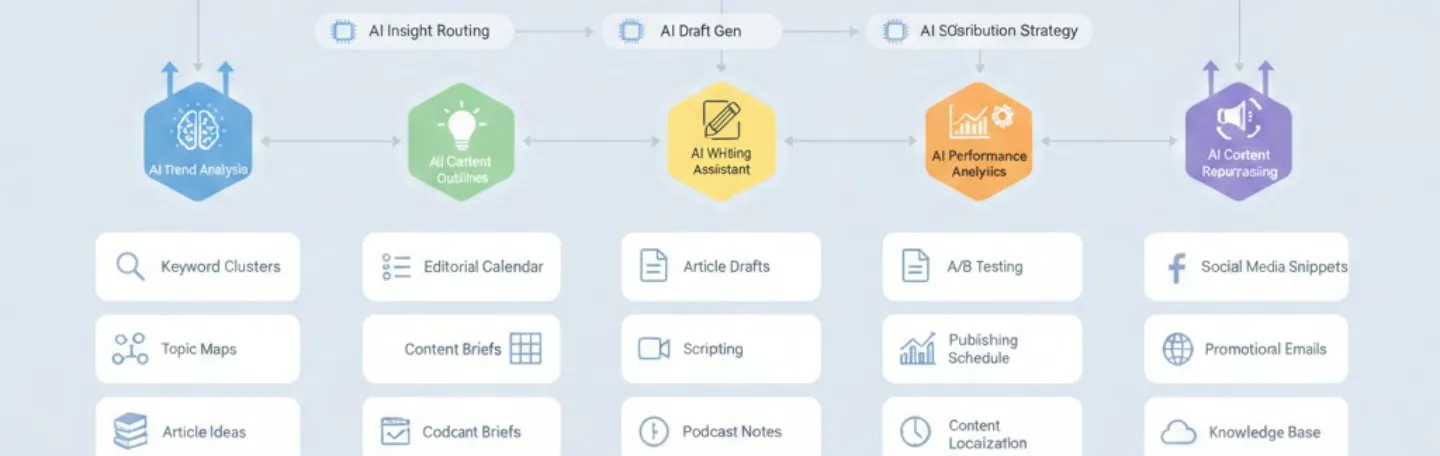
An AI content strategy isn’t about replacing writers with software. It’s about using AI intelligently across the entire content lifecycle:
- Research
- Planning
- Creation
- Optimization
- Distribution
- Scaling
In short, AI supports your thinking. It doesn’t do your thinking for you.
The biggest shift in content strategy in the age of AI is this: speed is easier than ever. Quality and differentiation are harder than ever.
Anyone can generate 50 blog posts this week. That’s not impressive. What matters is whether those posts actually deserve to rank.
Why Most AI Content Fails
Let’s be honest. A lot of AI content reads like it was written by… well, AI.
It’s safe. Generic. Over-explained. And forgettable.
Google sees that too.
Here’s why most AI-driven strategies collapse:
- They chase keywords without understanding intent.
- They publish without building topic authority.
- They optimize for rankings, not usefulness.
- They skip human editing.
AI makes production easier. It doesn’t automatically make content better.
If your process is “generate, lightly edit, publish,” you’re building a content graveyard.
Step 1: Plan Smarter Before You Write Anything
Everything starts with planning. If this step is weak, nothing else saves you.
Start With Search Intent, Not Just Keywords
Yes, your focus term might be AI Content Strategy. But ask yourself:
- What does the searcher actually want?
- Are they learning?
- Comparing tools?
- Trying to implement a system?
An article that ranks today answers intent clearly and directly.
This is where advanced research platforms help. People often ask, what is Search Atlas AI SEO software and why does it matter? Tools like that go beyond keyword volume. They analyze topic clusters, semantic relationships, and competitive gaps. That’s how you build depth instead of surface-level content.
Planning today isn’t about finding one keyword. It’s about mapping an ecosystem of related questions.
Build Topic Authority, Not Isolated Posts
A strong ai content strategy connects content together logically.
Instead of publishing one article on AI content strategy, you might create:
- A core guide (like this one)
- A breakdown of AI content workflows
- A piece on human editing frameworks
- A guide to AI content optimization
- A comparison of AI tools
Google rewards topical authority. Not random publishing.
If you want to scale intelligently, structure matters more than speed.
Step 2: Use AI to Create Faster (Without Losing Your Voice)
Here’s where things get interesting.
Most people either:
- Overuse AI and publish robotic content
- Or avoid it entirely out of fear
Neither extreme works.
Where AI Shines
AI is excellent at:
- Generating first drafts
- Expanding bullet points
- Summarizing research
- Rewriting for clarity
- Brainstorming angles
Used properly, AI tools for SEO can cut production time in half.
But here’s the key: AI gives you clay. You still have to sculpt it.
How to Use AI in Your Content Strategy the Right Way
If you’re wondering how to use AI in your content strategy, think of it like this:
- You define the structure.
- AI fills in the framework.
- You refine, sharpen, and personalize.
Add real examples. Add perspective. Add strong opinions. Add clarity.
AI-generated text without human editing feels empty. Human-edited AI content feels sharp and efficient.
That difference shows up in rankings.
Step 3: Optimize for Google’s AI Overviews
This is where things change significantly.
AI Overviews don’t work like traditional rankings. They extract concise, structured answers from content.
So if your page:
- Takes 800 words to answer a basic question
- Buries definitions
- Lacks clear structure
…it’s less likely to be featured.
Strategies for Optimizing Content for Google AI Overviews
Let’s get practical.
1. Answer Questions Directly
If someone asks, “What is an AI content strategy?” your page should provide a clean, immediate definition before diving deeper.
2. Use Clear Subheadings
Structure helps AI understand context.
3. Cover the Topic Fully
Don’t just define. Explain planning, execution, tools, risks, and measurement.
4. Avoid Fluff
AI doesn’t reward filler. Neither do readers.
Optimizing today isn’t about gaming algorithms. It’s about clarity and completeness.
Step 4: Build a Scalable Workflow
Creating one good article is manageable. Scaling 100 high-quality pieces is not—unless you build systems.
A scalable ai content strategy includes:
- Standardized content briefs
- Clear outline templates
- Defined tone guidelines
- Editorial review checkpoints
- Performance tracking loops
If your workflow changes every time you publish, you can’t scale.
We , at SEO Implementer, offer OTTO SEO implementer services—to maintain consistency across large publishing efforts.
Scaling is not about producing more. It’s about producing consistently high-quality work without chaos.
Step 5: Measure What Actually Matters
Vanity metrics are dangerous.
Traffic alone doesn’t tell you whether your AI content strategy works.
Instead, track:
- Visibility in AI Overviews
- Keyword clusters, not single terms
- Engagement time
- Scroll depth
- Conversion actions
If your content ranks but nobody engages, something is wrong.
If your content engages but doesn’t convert, your intent alignment is off.
AI can help analyze patterns. But interpretation still requires human judgment.
Common Mistakes That Quietly Kill Performance
Let’s call these out directly.
Publishing Unedited AI Content
Readers notice. So does Google.
Over-Optimizing Keywords
Semantic coverage beats repetition.
Ignoring Internal Linking
Authority builds through connections.
Producing Volume Without Strategy
More content does not equal more traffic.
In the age of AI, average content disappears faster than ever.
The Competitive Advantage Most Brands Miss
Here’s the thing.
AI gives everyone access to the same baseline capability. Drafting content is no longer the bottleneck.
Strategy is.
The brands winning right now are not necessarily the biggest. They’re the most structured.
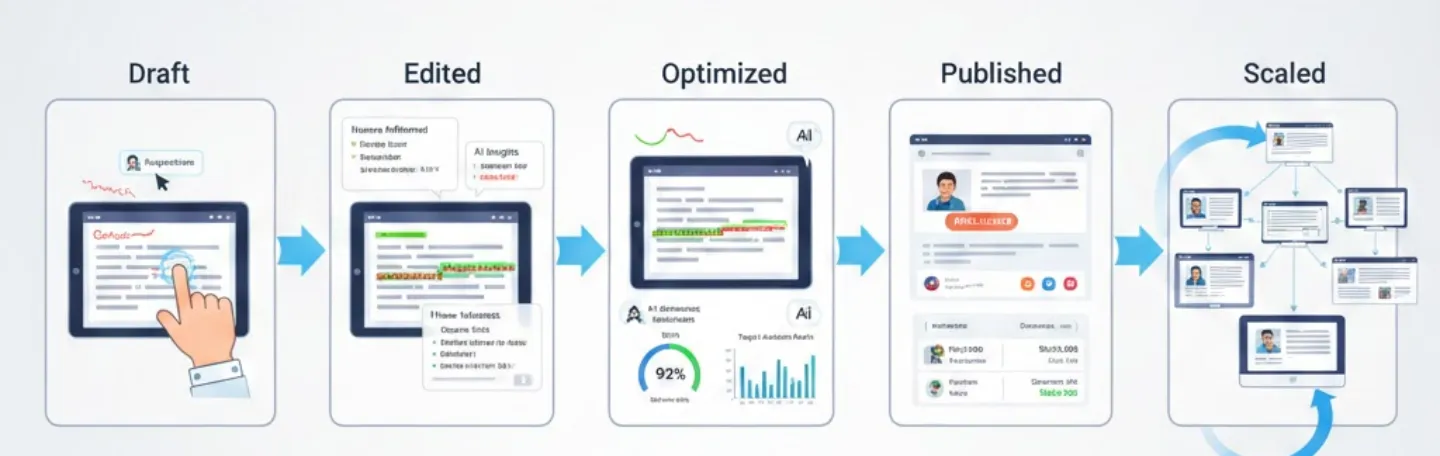
They:
- Research deeply
- Plan in clusters
- Write clearly
- Edit aggressively
- Optimize intelligently
- Measure realistically
That’s what modern content strategy in the age of AI looks like.
It’s disciplined.
Where AI Fits in the Bigger Picture
AI should sit inside your workflow—not replace it.
Think of your system like this:
Research Layer
AI identifies keyword clusters and content gaps.
Planning Layer
Humans define positioning and angle.
Drafting Layer
AI accelerates writing.
Refinement Layer
Humans sharpen, personalize, and differentiate.
Optimization Layer
SEO tools analyze structure and coverage.
Scaling Layer
Processes ensure consistency.
When you view AI as a tool inside a structured process, it becomes powerful. When you treat it as a shortcut, it becomes a liability.
A Quick Reality Check
Search is shifting fast.
AI Overviews are expanding. Semantic search is improving. Low-effort content is being filtered out.
That doesn’t mean AI content is bad.
It means lazy strategy is bad.
If you want your AI Content Strategy to succeed long term, focus on:
- Depth over noise
- Systems over hacks
- Clarity over cleverness
- Intent over keyword stuffing
AI amplifies whatever foundation you give it. If your foundation is weak, it amplifies weakness. If your foundation is strong, it multiplies output.
Final Thoughts
AI isn’t the future of content. It’s already here.
The question isn’t whether you should use it. The question is whether you’re using it intentionally.
A strong ai content strategy helps you:
- Move faster without cutting corners
- Adapt to algorithm changes
- Compete in crowded markets
- Scale output without losing quality
Search is becoming smarter. Content needs to do the same.
Build a system. Use AI intelligently. Stay focused on clarity and value.
That’s how you plan, create, and scale content the smart way.