Technical SEO used to mean spreadsheets, crawl logs, and long audit documents no one wanted to read.
Now? Things are changing fast.
AI for technical SEO is shifting how teams analyze sites, fix issues, and scale optimizations. Instead of spending hours digging through data, you can surface insights in minutes. Instead of manually checking thousands of URLs, you can automate the heavy lifting.
But here’s the thing: AI isn’t magic. It’s a multiplier. Used well, it sharpens your strategy. Used poorly, it just creates noise.
Let’s break down how AI fits into technical SEO, the real use cases that matter, and how to apply it without losing control of your strategy.
What Is AI for Technical SEO?
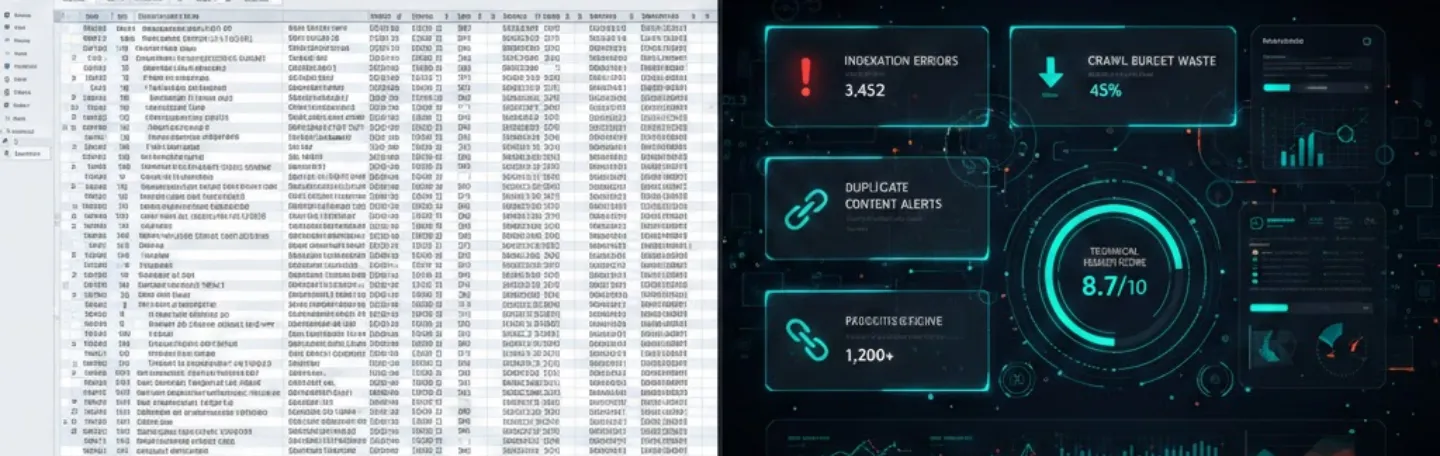
AI for technical SEO refers to using artificial intelligence—machine learning models, large language models, and automation systems—to analyze, diagnose, and optimize the technical foundation of a website.
This includes:
- Crawling and log file analysis
- Indexation diagnostics
- Internal linking improvements
- Schema generation
- Site structure optimization
- Page speed insights
- Automated reporting
- Scalable SEO audits
When people talk about generative AI for technical SEO, they’re usually referring to tools that don’t just analyze problems—but generate solutions. Think: auto-generating schema markup, suggesting internal links, rewriting meta tags at scale, or identifying crawl budget waste and proposing fixes.
The goal isn’t to replace SEO professionals. It’s to remove repetitive manual work so you can focus on decisions that move rankings and revenue.
Why AI Matters in Technical SEO
Technical SEO has always been data-heavy. Large sites can have:
- Tens of thousands of URLs
- Multiple subdomains
- Complex redirect chains
- Duplicate content variations
- Faceted navigation issues
- Crawl budget inefficiencies
Manually diagnosing these at scale is slow and error-prone.
AI changes that by:
- Recognizing patterns across massive datasets
- Prioritizing issues by impact
- Predicting ranking implications
- Automating repetitive fixes
- Continuously monitoring site health
What this really means is: instead of reacting to problems, you can proactively prevent them.
Core Use Cases of AI for Technical SEO
Let’s look at practical applications—not hype.
1. AI for Technical SEO Audits
Traditional audits are static. You run a crawl, export reports, and manually analyze everything.
AI-powered audits are dynamic.
With AI for technical SEO audits, tools can:
- Detect anomalies in crawl data
- Identify patterns in indexation drops
- Flag structural issues affecting clusters
- Analyze log files to uncover crawl waste
- Prioritize fixes by estimated traffic impact
Instead of giving you a 100-page PDF, AI can tell you:
“These 12 pages are cannibalizing each other. Fixing internal links here will likely improve rankings.”
That’s a different level of clarity.
2. Log File Analysis at Scale
Log files are gold—but most teams don’t analyze them deeply because it’s complex.
AI models can:
- Identify under-crawled but high-value pages
- Detect crawl traps
- Surface bot behavior anomalies
- Spot wasted crawl budget on parameter URLs
This becomes critical for large ecommerce or publishing sites where crawl efficiency affects revenue directly.
3. Internal Linking Optimization
Internal links influence authority flow, indexing, and topical relevance.
AI can:
- Map topic clusters automatically
- Identify orphan pages
- Suggest contextual internal links
- Optimize anchor text distribution
- Detect over-optimized patterns
Instead of guessing which pages should link together, AI analyzes semantic relationships and site structure to recommend the best connections.
This is where automation tools combined with services like SEO OTTO Implementer Services become powerful—you’re not just identifying opportunities, you’re executing them efficiently.
4. Schema & Structured Data Generation
Schema implementation is technical and time-consuming.
Generative AI for technical SEO can:
- Generate JSON-LD markup
- Recommend schema types per page
- Validate structured data
- Update schema at scale
For large sites, this removes a huge bottleneck. Instead of manually coding markup, you can generate and deploy structured data systematically.
5. Duplicate Content & Cannibalization Detection
Keyword cannibalization and duplicate content issues are hard to spot manually—especially across thousands of URLs.
AI can:
- Detect semantic overlap between pages
- Identify cannibalizing URLs
- Recommend consolidation or differentiation
- Suggest optimized page structures
It goes beyond simple keyword matching and understands content similarity at a deeper level.
6. Predictive SEO Insights
This is where things get interesting.
AI systems can analyze:
- Historical ranking data
- Crawl trends
- Core update patterns
- Content performance signals
From that, they can forecast potential ranking shifts or identify vulnerable pages.
While not perfect, this adds a layer of strategic foresight to technical SEO.
Tools Powering AI for Technical SEO
Not all AI tools are equal. Some focus on content. Others focus on analytics. A few integrate both.
If you’re exploring platforms that combine data analysis with automation, you may want to understand what is search atlas seo software and how it integrates AI into technical workflows.
Modern AI-driven SEO platforms typically include:
- Intelligent site crawlers
- Log file processing engines
- Automated technical audits
- Internal linking automation
- Schema generation modules
- Predictive ranking models
The key isn’t just that a tool uses AI. It’s whether it helps you act on insights quickly.
How AI Supports an AI Content Strategy
Technical SEO doesn’t live in isolation.
An effective ai content strategy depends on a strong technical foundation:
- Proper crawlability
- Clean internal linking
- Structured topic clusters
- Clear indexation signals
- Optimized site architecture
AI bridges technical SEO and content strategy by:
- Mapping content gaps
- Connecting content clusters via internal links
- Identifying thin or underperforming pages
- Ensuring technical health supports content expansion
If content is the engine, technical SEO is the infrastructure. AI connects both so growth is scalable.
Best Practices for Using AI in Technical SEO
Now let’s talk discipline.
AI can speed things up—but only if you use it properly.
1. Don’t Blindly Automate
Automation without oversight leads to:
- Over-optimized anchor text
- Broken schema
- Technical conflicts
- Ranking volatility
Always review major changes before deploying them site-wide.
2. Validate AI Recommendations
Treat AI suggestions as starting points, not final decisions.
Ask:
- Does this align with search intent?
- Will this impact UX negatively?
- Is this fix technically sound?
- Does it support broader SEO goals?
Human judgment still matters.
3. Prioritize Impact Over Volume
AI can surface 200 issues. That doesn’t mean you should fix all 200 immediately.
Focus on:
- Indexation problems
- Crawl inefficiencies
- High-traffic page errors
- Structural internal linking issues
Fix what moves the needle first.
4. Combine AI With Real Search Data
AI works best when combined with:
- Google Search Console data
- Analytics trends
- Log files
- Conversion insights
The more real-world data you feed into your system, the more accurate the outputs.
5. Monitor After Implementation
After deploying AI-driven changes:
- Track rankings
- Monitor crawl stats
- Watch indexation changes
- Measure traffic shifts
Technical SEO is iterative. AI speeds iteration—but doesn’t eliminate it.
Where AI Struggles (And Why That’s Okay)
Let’s be honest.
AI still struggles with:
- Nuanced business context
- Brand positioning decisions
- Complex international SEO setups
- Unique edge-case technical problems
It identifies patterns. It doesn’t fully understand your company’s strategy.
That’s your job.
Use AI to enhance expertise—not replace it.
The Future of AI for Technical SEO
We’re heading toward systems that:
- Continuously crawl and monitor sites
- Automatically fix minor issues
- Adjust internal links dynamically
- Update schema based on content changes
- Predict ranking shifts before they happen
Technical SEO will become more proactive and less reactive.
The professionals who thrive will be those who:
- Understand both AI systems and search fundamentals
- Know when to trust automation
- Know when to intervene
AI won’t eliminate technical SEO roles. It will raise the bar.
Final Thoughts
AI for technical SEO isn’t about replacing analysts with machines.
It’s about scaling intelligence.
When used properly, AI helps you:
- Audit faster
- Fix smarter
- Monitor continuously
- Scale efficiently
Whether you’re using AI for technical SEO audits, exploring generative AI for technical SEO, or integrating automation into a broader ai content strategy, the principle stays the same:
Use AI as a lever. Not a crutch.
The technical foundation of your site still determines how far your content can go.
AI just helps you build that foundation stronger—and a lot faster.