AI tools for SEO aren’t new anymore. What’s new in 2026 is how clearly the winners have separated themselves from the noise.
A few years ago, most “AI SEO tools” focused on content generation. That phase passed quickly. Search engines got better at detecting low-value content, and marketers realized that speed without structure doesn’t produce rankings.
Today, the best AI tools for SEO help teams analyze SERPs, optimize pages intelligently, automate internal linking, and maintain rankings over time. The tools that matter don’t just suggest what to do — they help you do it.
This guide breaks down:
- What AI tools for SEO actually do well in 2026
- The best AI SEO tools by use case
- When to use each tool
- Which tools work best for small businesses vs larger teams
- Why implementation matters more than features
If you’re evaluating best AI tools for SEO, or looking for ai seo tools for small business that actually move the needle, this is the clarity most roundups skip.
What “AI Tools for SEO” Really Means in 2026
AI in SEO isn’t about shortcuts anymore. It’s about precision.
In 2026, AI tools are best used for:
- SERP pattern recognition
- Semantic keyword analysis
- On-page SEO optimization
- Internal linking automation
- Content decay detection
- Continuous optimization
What AI doesn’t do well on its own:
- Strategy
- Brand positioning
- Judgment calls
- Understanding business priorities
The strongest SEO teams use AI to eliminate manual work — not thinking.
Why AI SEO Tools Matter More Than Ever
Search engines now evaluate:
- Topic depth
- Content structure
- Internal relationships between pages
- Search intent alignment
- Content freshness
Trying to manage all of this manually across dozens or hundreds of pages doesn’t scale. That’s why AI tools for SEO have shifted from “nice to have” to essential infrastructure.
But not all tools are built for the same job.
Categories of AI Tools for SEO (And Why This Matters)
Most people fail at tool selection because they lump everything together.
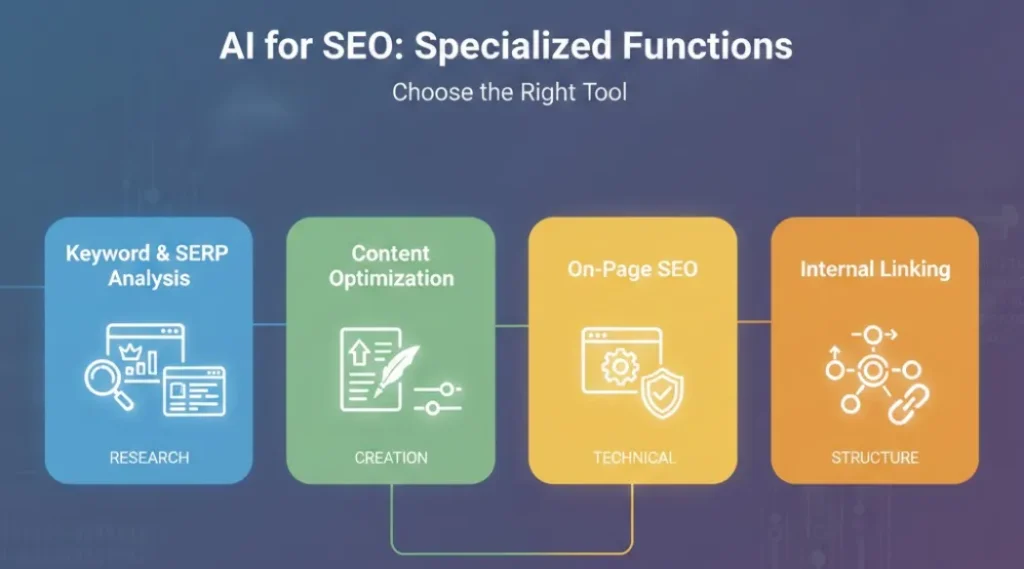
In reality, AI SEO tools fall into six functional categories:
- Keyword & SERP intelligence
- On-page SEO optimization
- Content optimization & semantic coverage
- Internal linking automation
- Technical SEO & monitoring
- Implementation & execution
Understanding this breakdown helps you choose tools that complement each other instead of overlap.
1. OTTO SEO — Best AI Tool for On-Page SEO Automation & Execution
Best for:
On-page SEO, internal linking, scalable execution, automation
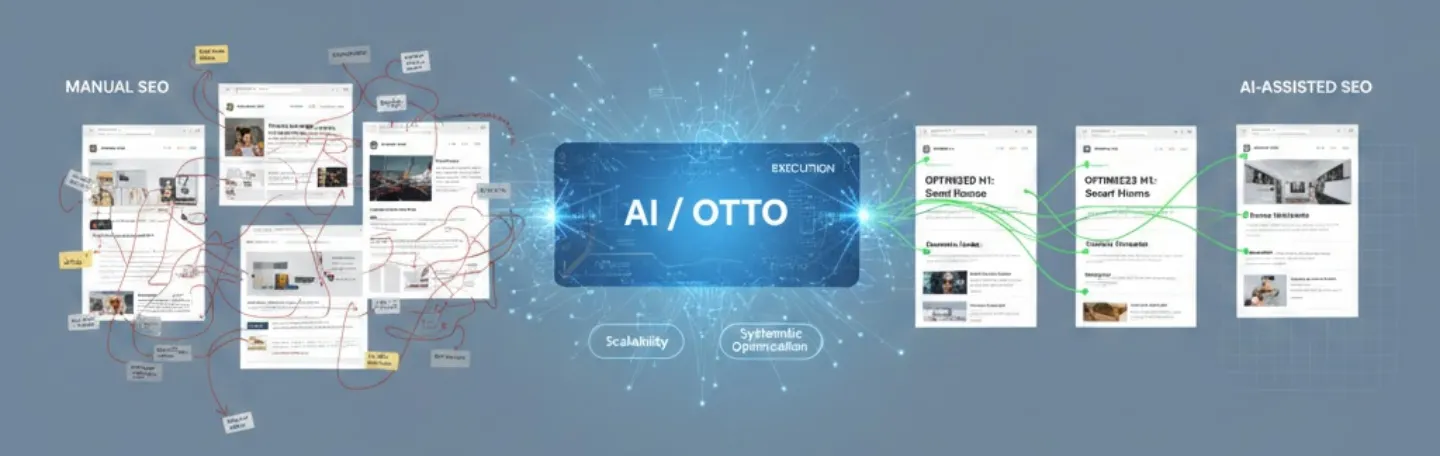
OTTO SEO stands apart because it focuses on implementation, not just analysis.
Key Features
- SERP-driven on-page SEO recommendations
- Heading and keyword optimization
- Automated internal linking based on topical relevance
- Content gap detection
- Continuous optimization across large content libraries
Most tools stop at “here’s what you should fix.”
OTTO helps apply those fixes systematically.
That’s a critical distinction — especially for teams managing dozens or hundreds of URLs.
When to Use OTTO SEO
- Scaling on-page SEO across many pages
- Maintaining internal linking consistency
- Managing topic clusters
- Preventing content decay
- Turning SEO insights into action
OTTO becomes even more powerful when paired with SEO OTTO Implementer Services, where setup, configuration, and execution are handled by specialists instead of trial-and-error.
2. Surfer SEO — Best for Content Optimization During Writing
Best for:
On-page content optimization, writer guidance
Surfer SEO is widely used because it bridges SEO and writing well.
Key Features
- SERP-based content scoring
- Keyword and term recommendations
- Heading and word-count guidance
- Real-time optimization feedback
Surfer SEO excels at helping writers understand what top-ranking pages include — and what they’re missing.
Limitations
- No automation or execution layer
- Internal linking is manual
- Recommendations still need implementation
Surfer is a guidance tool, not a scaling tool.
When to Use Surfer SEO
- Writing new blog content
- Optimizing individual pages
- Supporting editorial teams
Surfer works best alongside an execution-focused platform.
3. Clearscope — Best for Semantic SEO & Editorial Precision
Best for:
Semantic keyword coverage, editorial SEO
Clearscope focuses heavily on relevance and term importance.
Key Features
- Semantic term grading
- Content relevance scoring
- SERP-driven topic analysis
- Clean editorial workflows
Clearscope helps ensure content covers concepts Google expects — not just keywords.
Limitations
- Expensive for small teams
- No internal linking automation
- No technical or execution layer
When to Use Clearscope
- High-value editorial content
- Thought leadership pieces
- Pages where semantic precision matters
Clearscope is excellent for polish, not scale.
4. Frase — Best for Research, FAQs, and Content Briefs
Best for:
Content research, outlines, FAQs
Frase shines in early-stage content planning.
Key Features
- SERP question extraction
- “People Also Ask” analysis
- AI-assisted content briefs
- FAQ optimization
Frase helps uncover what users actually ask — which is valuable for long-tail traffic.
Limitations
- Limited on-page automation
- Manual publishing required
- Not designed for site-wide optimization
When to Use Frase
- Research-heavy blog content
- FAQ sections
- Informational SEO content
Frase is an ideation engine, not a ranking engine by itself.
5. MarketMuse — Best for Topical Authority & Content Strategy
Best for:
Content planning, topical authority, gap analysis
MarketMuse operates at a strategic level.
Key Features
- Topic modeling
- Authority scoring
- Content gap identification
- Strategic planning insights
It answers questions like:
“What should we write next to dominate this topic?”
Limitations
- High cost
- Steep learning curve
- Minimal execution capabilities
When to Use MarketMuse
- Enterprise SEO teams
- Long-term content planning
- Building topical authority roadmaps
MarketMuse helps you decide, not execute.
6. Jasper — Best for Assisted Content Drafting (With Oversight)
Best for:
Speeding up content drafts
Jasper helps marketers write faster — but it’s not an SEO system.
Key Features
- AI-assisted writing
- Brand voice controls
- Workflow integrations
Limitations
- No SERP analysis
- No internal linking logic
- Requires SEO tools alongside it
When to Use Jasper
- First drafts
- Marketing copy with SEO input
- Teams with strong editors
Jasper supports writing — not optimization.
Internal Linking: Where AI Makes the Biggest Difference
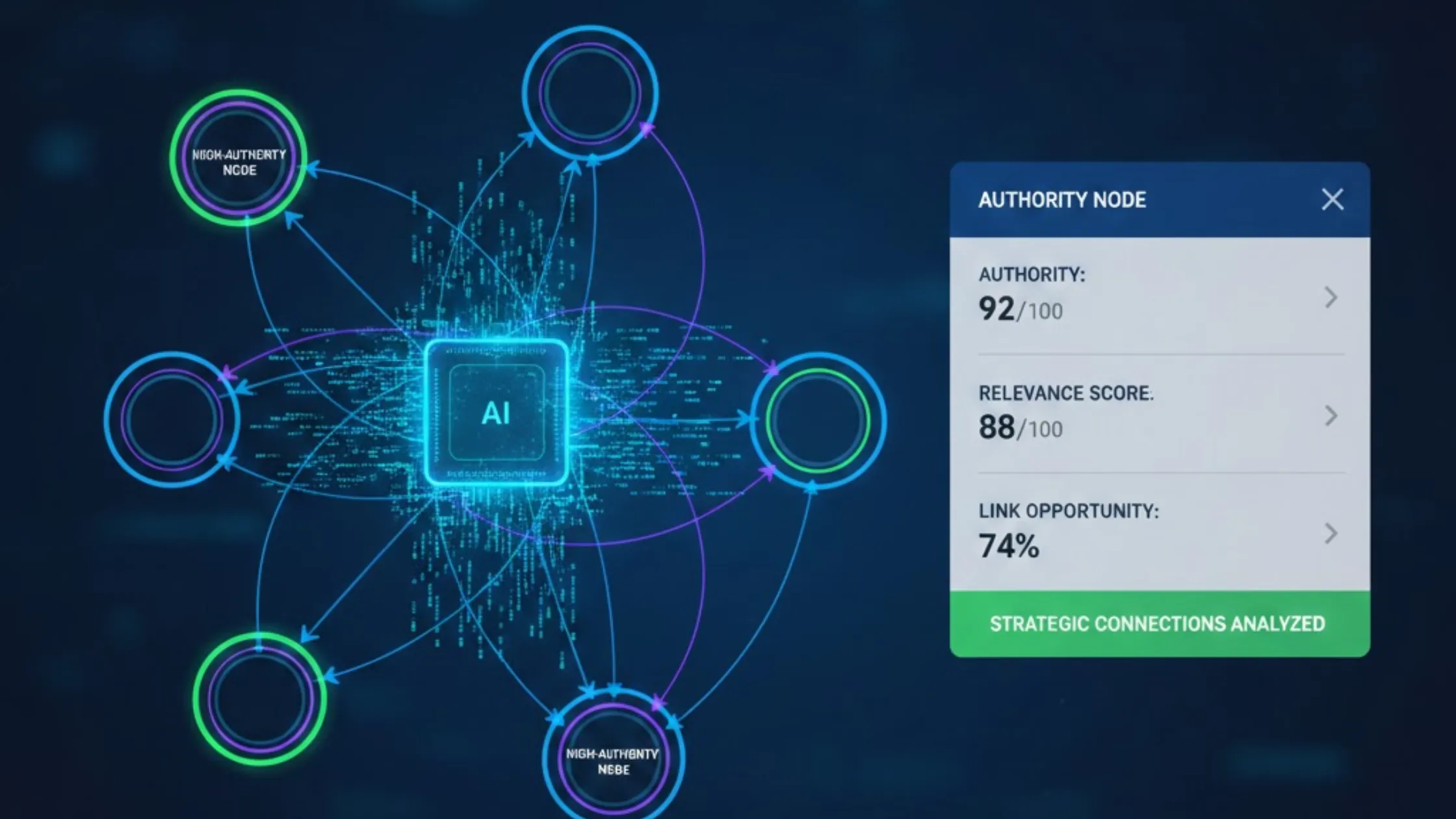
Internal linking is one of the most powerful SEO levers — and one of the least optimized.
AI changes that.
Instead of manually adding links, AI tools:
- Scan your entire site
- Identify contextual linking opportunities
- Strengthen topic clusters
- Prevent over-linking
A strong internal linking strategy improves crawlability, distributes authority, and helps pages rank faster — especially when paired with on-page optimization.
This is where platforms like OTTO shine, because internal linking isn’t treated as an afterthought.
AI Tools for SEO for Small Business: What Actually Matters
Small businesses don’t need more tools. They need fewer tools that do more.
For ai seo tools for small business, priorities should be:
- Ease of use
- Clear recommendations
- Minimal setup
- Strong ROI
Tools that require heavy configuration or constant babysitting usually fail at this level.
Execution-focused platforms outperform “feature-rich” dashboards here.
Why Tools Alone Don’t Deliver SEO Results
Here’s the part most blogs won’t say clearly:
SEO tools don’t rank pages. Implementation does.
Common problems:
- Recommendations never get applied
- Tools are misconfigured
- Teams don’t revisit optimizations
- Internal linking is ignored
That’s why execution layers and services exist.
Where SEO OTTO Implementer Services Fit In
SEO OTTO Implementer Services bridge the gap between insight and action.
Instead of:
- Learning complex tools
- Manually applying changes
- Hoping nothing breaks
Implementation services:
- Configure OTTO properly
- Apply on-page SEO and internal linking
- Monitor performance
- Continuously refine results
This turns AI tools from reports into outcomes.
How the Best AI SEO Tools Work Together
The strongest SEO stacks in 2026 don’t rely on one tool.
They combine:
- Research & guidance (Surfer, Frase, Clearscope)
- Strategy & planning (MarketMuse)
- Execution & automation (OTTO SEO)
- Monitoring & updates (OTTO + analytics)
OTTO acts as the connective tissue — the layer that ensures work actually gets done.
Common Mistakes When Using AI SEO Tools
Even the best tools can hurt performance if misused.
Avoid:
- Publishing unreviewed AI content
- Over-optimizing pages
- Ignoring user intent
- Treating tools as strategy
AI supports SEO — it doesn’t replace it.
Final Thoughts: Choosing the Right AI Tools for SEO in 2026
AI tools for SEO aren’t optional anymore. But more tools don’t equal better results.
The best setups:
- Focus on relevance and structure
- Automate repeatable work
- Strengthen internal linking
- Support topical authority
- Prioritize execution over experimentation
Whether you’re exploring best ai tools for seo, evaluating ai seo tools for small business, or scaling enterprise SEO with search atlas ai seo software and SEO OTTO Implementer Services, the rule stays the same:
AI works when it’s structured, intentional, and implemented.
Tools show possibilities.
Systems produce rankings.