Topical authority SEO isn’t a buzzword. It’s the quiet reason some sites rank with average backlinks while others can’t move despite throwing money at links, tools, and content volume.
Google doesn’t reward websites for publishing a lot. It rewards websites that prove they understand a topic better than most other options on the web. That proof isn’t a single article. It’s a pattern—across pages, links, entities, and intent coverage.
That’s what topical authority is really about.
This guide breaks down:
- what topical authority in SEO actually means,
- how Google evaluates it,
- why topic clusters matter more than standalone posts,
- and how to build authority using content, internal links, and AI—without trashing trust.
No theory dumps. No recycled SEO myths. Just what actually works now.
What Is Topical Authority in SEO?
Let’s clear the fog first.
Topical authority in SEO is Google’s assessment of how comprehensively and consistently a website covers a subject area.
Not a keyword.
Not a page.
A topic.
When Google sees your site as a reliable source on a subject, it becomes more willing to:
- rank your new pages faster,
- trust your internal links,
- and place your content above competitors with more backlinks.
That’s the leverage.
What Topical Authority Is Not
Before we go deeper, here’s what it isn’t:
- Publishing hundreds of loosely related blog posts
- Keyword stuffing variants of the same phrase
- Creating thin “SEO pages” to check boxes
- Relying on backlinks alone
Google has moved past that.
Topical authority is about coverage + relationships + intent satisfaction.
How Google Actually Measures Topical Authority
Google doesn’t have a “topical authority score” you can see—but it absolutely models authority internally using signals that cluster together.
Here’s what matters.
1. Depth of Coverage
Google looks at whether your site covers:
- core concepts,
- subtopics,
- supporting questions,
- edge cases,
- and related entities.
If your site talks about topical authority SEO, Google expects to also see:
- explanations,
- implementation strategies,
- internal linking logic,
- AI implications,
- tooling,
- and examples.
One article won’t cut it.
2. Semantic Relationships (Entities, Not Just Keywords)
Google reads content using entities and relationships, not just strings of text.
So when you explain what is topical authority in SEO, Google also expects references to:
- search intent,
- internal linking,
- content clusters,
- E-E-A-T,
- crawl paths,
- and topical relevance.
If those concepts are missing, your content feels shallow—even if it’s long.
3. Internal Linking Patterns
Internal links aren’t just navigation. They’re signals of topical structure.
A strong authority site:
- links from broad pages → narrow pages,
- reinforces key hub pages repeatedly,
- uses consistent, descriptive anchor text,
- and avoids orphaned content.
This is where most sites fall apart.
4. Consistency Over Time
Authority compounds.
Sites that publish consistently within a topic—and update intelligently—send a stronger trust signal than sites that bounce between unrelated subjects.
Random content kills authority.
Why Topic Clusters Are the Backbone of Topical Authority SEO
A topic cluster is not:
- a hub page plus a few blog posts slapped together, or
- an internal linking diagram you never revisit.
A real topic cluster is a content ecosystem.
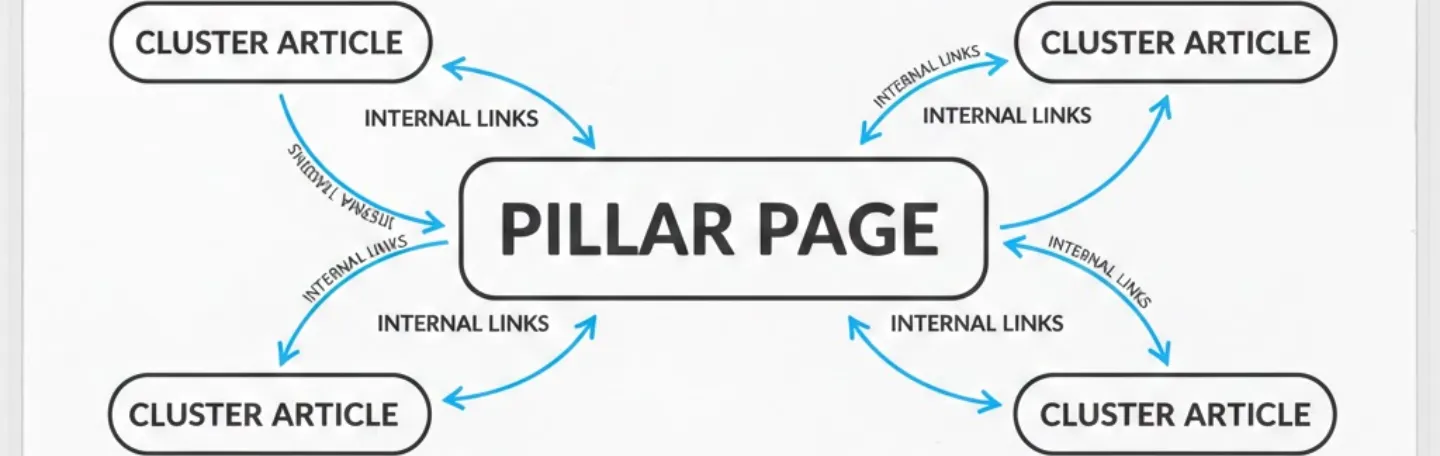
Pillar Pages vs Cluster Pages
Here’s the clean distinction:
Pillar page
- Covers the topic at a high level
- Targets broader queries
- Acts as the central authority node
Cluster pages
- Go deep into subtopics
- Answer specific questions
- Reinforce the pillar semantically and structurally
Your pillar page for this topic is exactly what you’re reading now.
Why Standalone Content Fails (Even If It’s “Good”)
This is uncomfortable but important.
You can write an excellent article—and still not rank—if it exists in isolation.
Google asks:
“Is this page supported by the rest of the site?”
If the answer is no, rankings stall.
That’s why topical authority SEO outperforms traditional keyword-first strategies. It removes dependency on individual pages performing miracles on their own.
Internal Linking: The Most Underrated Authority Signal
Internal linking is where topical authority becomes visible to search engines.
Think of internal links as:
- pathways for crawlers,
- context signals for content,
- and authority distribution channels.
How Most Sites Do It Wrong
Common mistakes:
- Random “related posts” widgets
- Inconsistent anchor text
- Linking only from menus
- No clear hierarchy
This creates noise, not clarity.
How Authority Sites Do It Right
Strong internal linking:
- reinforces topic relationships,
- uses intentional anchor text,
- points repeatedly to core pages,
- and flows from general → specific.
For example, when discussing content scaling, it makes sense to reference ai content for SEO—not as a throwaway mention, but as a connected subtopic that deserves its own depth.
That’s how Google learns your structure.
Where AI Content Fits in Topical Authority (And Where It Doesn’t)
Let’s address the elephant in the room.
AI didn’t kill SEO.
Bad strategy did.
Can AI Content Build Topical Authority?
Yes—if it’s used correctly.
AI helps with:
- coverage expansion,
- entity inclusion,
- content velocity,
- and consistency.
AI fails when:
- it produces generic summaries,
- content isn’t reviewed,
- internal linking is ignored,
- or everything sounds the same.
Topical authority requires cohesion, not just output.
That’s why tools matter.
Understanding what is Search Atlas AI SEO software becomes relevant here—not as hype, but as infrastructure. Tools that map topics, entities, and internal links help enforce authority at scale instead of relying on human memory.
Authority Is Built Systematically, Not Page by Page
Here’s the mindset shift most SEOs miss:
You’re not ranking pages.
You’re training Google how to interpret your site.
Every article should:
- reinforce a topic,
- strengthen a hub,
- and clarify relevance.
When done right, newer pages rank faster because authority already exists.
That’s the compounding effect.
Services vs DIY: When Implementation Becomes the Bottleneck
At a certain scale, execution—not knowledge—becomes the constraint.
Mapping clusters, maintaining internal links, updating content, and aligning AI output takes real systems. This is where structured solutions like SEO OTTO Implementer Services make sense for teams that don’t want authority decay as content grows.
The goal isn’t automation for its own sake—it’s maintaining topical clarity as volume increases.
What This Really Means for Your SEO Strategy
If you take one thing from this section, make it this:
Google rewards sites that behave like subject-matter experts, not content factories.
Topical authority SEO works because it aligns with how search engines now evaluate trust, relevance, and usefulness at scale.
In the next sections of this guide, we’ll break down:
- how to design topic clusters from scratch,
- how to map internal links intentionally,
- how many articles you actually need,
- and how to measure authority growth over time.
For now, this foundation matters more than tactics.