Google AI Overviews are changing how search works—fast.
Instead of showing ten blue links and letting users decide, Google now answers many queries directly using AI-generated summaries pulled from multiple sources. For SEO, this means visibility is shifting from traditional rankings to being cited inside AI answers.
If your content isn’t used by Google’s AI, you’re effectively invisible—even if you rank.
This guide explains how to SEO for Google AI Overview, how Google selects sources for AI answers, and how to structure content so it gets featured.
What Are Google AI Overviews (And Why They Matter for SEO)
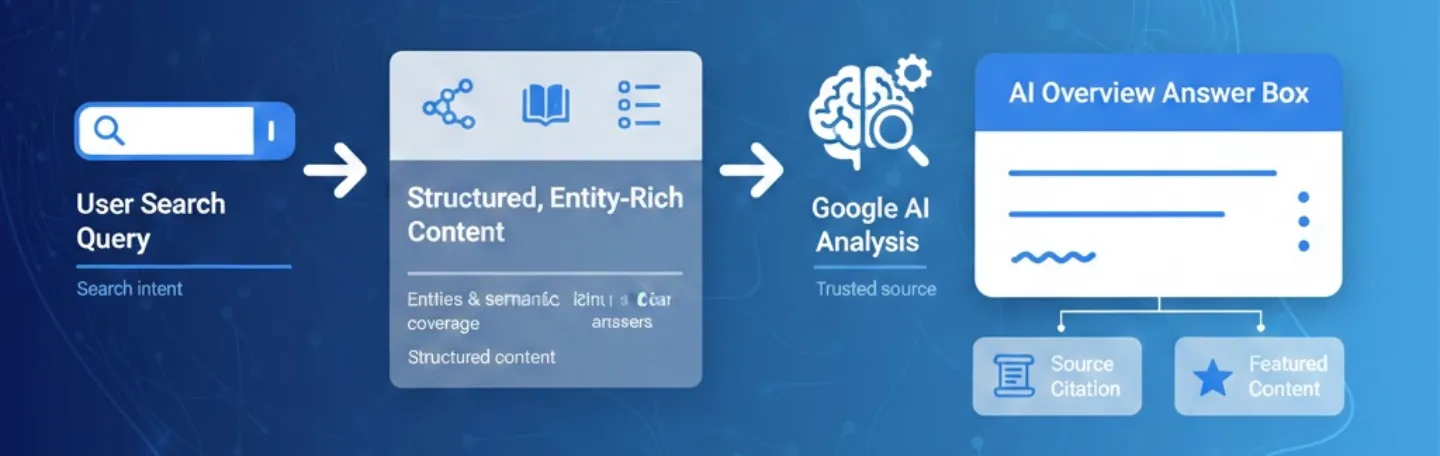
Google AI Overviews are AI-generated responses that appear at the top of search results for many informational, how-to, and comparison queries.
They:
- summarize answers from multiple sources
- cite websites Google trusts
- reduce reliance on traditional blue links
- prioritize clarity, authority, and structure
This changes the SEO goal.
You’re no longer just trying to rank pages.
You’re trying to become a trusted source that Google’s AI pulls from.
How Google Chooses Content for AI Overviews
Google AI doesn’t select content randomly. Pages featured in AI Overviews usually show:
- strong topical authority
- clear entity coverage
- direct, concise answers
- logical structure
- alignment with search intent
In short, Google AI prefers content that explains things cleanly and completely.
That’s why surface-level blog posts struggle—and well-structured, expert-driven content wins.
How to SEO for Google AI Overview (Core Strategy)
1. Target Answer-Focused Queries
AI Overviews typically appear for:
- “how to” searches
- explanations and definitions
- comparisons
- process-based questions
That’s why queries like how to seo for google ai overview are ideal targets.
Your page should:
- answer the question early
- explain the process clearly
- expand with structured detail
If the answer is buried, Google won’t use it.
2. Structure Content for AI Readability
Google AI prefers content that’s easy to extract from.
That means:
- clear H2s and H3s
- short, direct paragraphs
- step-by-step sections
- bullet points
- FAQ-style explanations
Think less storytelling—more structured expertise.
3. Optimize for Entities, Not Just Keywords
AI Overviews rely heavily on entities and relationships.
Your content should naturally include:
- the core topic
- related subtopics
- tools
- processes
- supporting concepts
This is where a solid ai keyword research tool helps—because it surfaces the entities and semantic topics Google already associates with AI Overviews.
4. Answer Follow-Up Questions on the Same Page
Google often pulls AI answers from pages that cover:
- the main question
- related PAA-style questions
- clarifications and follow-ups
This is why FAQs and explainer sections dramatically increase AI Overview visibility.
How to Get Into Google AI Overview for SEO
Pages that consistently appear in AI Overviews usually share a few traits.
Clear Authority Signals
They:
- explain why, not just what
- provide actionable guidance
- avoid vague, generic advice
Strong On-Page SEO
AI still relies on traditional SEO signals:
- optimized headings
- internal linking
- topical focus
- clean formatting
Weak on-page SEO = weak AI visibility.
Consistent Topical Coverage Across the Site
AI Overviews favor sites that show depth.
That means:
- multiple related articles
- clear internal linking
- focused topical authority
One isolated post rarely wins alone.
How to Implement SEO for Google AI Overviews (Step-by-Step)
Step 1: Find AI Overview Opportunities
Look for queries where:
- AI Overviews already appear
- intent is informational
- answers can be summarized
These are your targets.
Step 2: Build an AI-Friendly Outline
Your outline should include:
- a direct answer near the top
- step-by-step guidance
- supporting subtopics
- FAQs
Avoid filler. AI doesn’t reward fluff.
Step 3: Optimize for Semantic Coverage
Instead of keyword repetition, focus on:
- covering related concepts
- explaining processes clearly
- using natural language
This aligns with how Google AI understands topics.
Step 4: Strengthen Internal Linking
Internal links help Google understand:
- topical relationships
- content hierarchy
- authority depth
This is especially important for AI-driven search topics.
Tools That Support Google AI Overviews SEO
You don’t need dozens of tools—but you do need the right ones.
Platforms that focus on AI-driven SEO workflows make a big difference. If you’re exploring what is search atlas ai SEO software, it’s built to support modern SEO by helping identify AI-triggering queries, intent gaps, and entity coverage needed for AI-friendly content.
When paired with a strong ai keyword research tool, this allows you to plan content specifically for AI extraction—not just rankings.
Why Implementation Is the Real Differentiator
Here’s the reality:
Most sites won’t fail at AI Overview SEO because of bad ideas.
They’ll fail because of poor execution.
Common problems include:
- unstructured content
- weak internal linking
- missing entity coverage
- inconsistent optimization
AI Overviews reward precision.
That’s why SEO OTTO Implementer Services focuses on execution—turning AI-focused SEO strategies into properly structured, internally linked, and optimized content that Google can actually use.
What Success With Google AI Overviews Looks Like
When your SEO aligns with AI Overviews, you’ll notice:
- visibility without traditional ranking movement
- impressions above position #1
- increased brand authority
- stronger topical signals site-wide
You’re no longer competing only for clicks.
You’re competing to be the source.
Final Thoughts: AI Answers Are the New SEO Battleground
Google AI Overviews aren’t coming—they’re already here.
To stay visible, you need to shift from:
- ranking-only SEO
to - answer-first, entity-driven SEO
Learn how to implement seo for google ai overviews, structure content for AI understanding, and execute consistently.
Because in AI-powered search, the brands that win aren’t louder.
They’re clearer.